
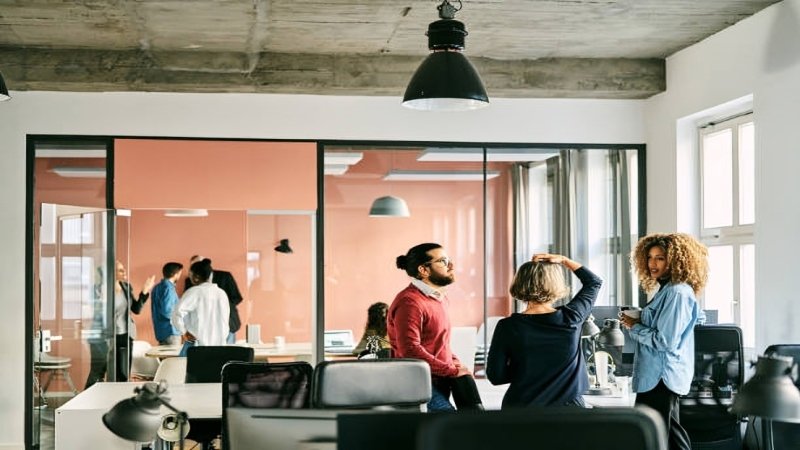
The open-plan office was supposed to be the future. Tech companies tore down walls, removed cubicles, and created sprawling spaces where collaboration could happen spontaneously. Executives praised the transparency and energy of these designs. But something unexpected happened along the way: people started craving walls again.
Walk into any major tech company today, and you’ll notice something curious. Scattered throughout those vast open floors are small, enclosed spaces that look almost like phone booths from another era. These aren’t nostalgic decorations. They’re the solution to a problem that took years to fully understand.
The Promise That Didn’t Deliver
Open-plan offices were built on an appealing theory. Remove barriers between people, and you remove barriers between ideas. Conversations would flow naturally. Teams would bond effortlessly. Innovation would accelerate simply because everyone could see and hear each other working.
The reality proved more complicated. While spontaneous conversations did increase, so did constant interruptions. Background noise became a persistent companion to every task. Private phone calls required walking outside or hiding in stairwells. Deep work became nearly impossible during normal office hours. Employee surveys began revealing what managers didn’t want to hear: people were exhausted and distracted.
The Quiet Counter-Revolution
Rather than admit defeat and rebuild walls everywhere, companies found a middle path. They began installing small, soundproof enclosures throughout their offices. These spaces offer something the open plan couldn’t: the ability to choose your environment based on what your work requires at any given moment.
Need to join a video call without disturbing your neighbors? Step into one of these booths. Working on a complex problem that requires uninterrupted thought? Claim a quiet space for an hour. Having a sensitive conversation with a colleague or manager? These rooms provide the privacy that used to come standard with offices.
Why This Matters Beyond Comfort
The shift toward these enclosed spaces represents more than just a correction to an architectural mistake. It reflects a deeper understanding of how different types of work require different environments. Creative brainstorming might thrive in an open setting, but analytical problem-solving often needs quiet. Sales calls require privacy, while casual team lunches benefit from social energy.
Acoustic Booths have become physical manifestations of a more mature workplace philosophy: one that acknowledges human needs vary throughout the day and across different tasks. The best office isn’t one that forces everyone into the same environment all the time.
The Technology Connection
Tech companies, ironically, were among the slowest to recognize this need despite being the biggest proponents of open plans. Perhaps this makes sense. The industry’s focus on disruption and innovation sometimes leads to overcorrecting away from traditional structures without fully considering what was lost.
Now, these same companies are leading the charge in the opposite direction. They’re not returning to private offices for everyone, but they’re creating flexibility within open spaces. The result is a hybrid environment where people can move between collaborative and focused settings as their work demands.
What This Means for the Future
The proliferation of these small, quiet spaces suggests that the future of office design isn’t about choosing between open or closed, collaborative or focused. It’s about providing options. Employees increasingly expect workplaces that adapt to their needs rather than forcing them to adapt to rigid spatial arrangements.
This shift also hints at a broader trend: companies recognizing that productivity isn’t just about bringing people together physically. It’s about giving them the tools and environments they need to do their best work, whether that means collaboration spaces, quiet zones, or the flexibility to choose between them.
The rebellion against open-plan offices isn’t really a rebellion at all. It’s an evolution toward something more thoughtful and human-centered than what came before.
