
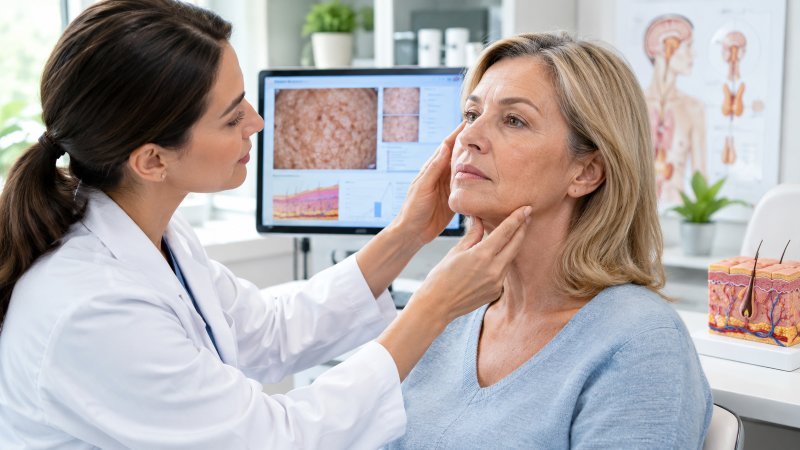
Growth hormone plays a far broader role in human physiology than its name suggests. While most people associate it with childhood development and stature, this peptide hormone continues to influence tissue repair, metabolic function, and cellular regeneration throughout adult life. One of its less recognized but clinically significant effects involves the maintenance of skin structure and appearance. When growth hormone production falls below normal levels, the skin often shows visible changes that can be mistaken for accelerated aging or dermatological disease.
The Biological Link Between Growth Hormone and Skin Structure
Growth hormone stimulates the production of insulin-like growth factor 1 (IGF-1) in the liver and peripheral tissues, including the skin. IGF-1 promotes the synthesis of collagen and elastin, the structural proteins that give skin its firmness and elasticity. It also enhances the proliferation of fibroblasts, the cells responsible for maintaining the extracellular matrix in the dermis. When growth hormone secretion declines, either through pituitary dysfunction or as part of normal aging, these processes slow down.
The result is a measurable reduction in dermal thickness. Studies using ultrasound and biopsy have documented that adults with growth hormone deficiency often have skin that is 15 to 20 percent thinner than age-matched controls. This thinning is not uniform across the body; it tends to be most pronounced in areas with naturally delicate skin, such as around the eyes and on the backs of the hands. The epidermis may also show reduced cell turnover, leading to a dull or sallow complexion.
Visible Signs and Symptoms
Patients with untreated growth hormone deficiency frequently report skin that appears dry, thin, and less resilient. Fine wrinkles may become more prominent, and the skin may bruise more easily due to weakened capillary support. Some individuals notice a loss of subcutaneous fat, which contributes to a hollowed or aged appearance, particularly in the face. Wound healing may also be slower, and minor abrasions or cuts take longer to close and regenerate.
These changes are often gradual and can be difficult to distinguish from other causes of skin aging or nutritional deficiency. However, when they occur alongside other symptoms of growth hormone deficiency, such as reduced exercise capacity, increased body fat, low bone density, or persistent fatigue, they warrant further investigation. The overlap between endocrine and dermatological symptoms highlights the importance of cross-specialty evaluation in cases where skin changes do not respond to conventional topical treatments.
Diagnostic Pathways and Hormonal Assessment
Diagnosing growth hormone deficiency requires biochemical confirmation, as the clinical presentation can be subtle. The standard approach involves measuring IGF-1 levels in the blood, which serve as a proxy for growth hormone activity. If IGF-1 is low or borderline, a stimulation test may be performed to assess the pituitary gland’s capacity to release growth hormone in response to provocative agents such as insulin, arginine, or glucagon.
For patients presenting with skin-related concerns, collaboration between endocrinology and dermatology is often valuable. A dermatologist can rule out primary skin conditions such as atopic dermatitis, autoimmune connective tissue disorders, or nutritional deficiencies that mimic the appearance of hormone-related skin changes. Understanding the underlying mechanisms, such as dual pathway somatotroph activation, can help clinicians interpret test results and refine treatment strategies.
Treatment and Skin Recovery
Growth hormone replacement therapy, when medically indicated, can reverse many of the skin changes associated with deficiency. Clinical trials have shown that adults receiving daily subcutaneous injections of recombinant human growth hormone experience a measurable increase in skin thickness within six to twelve months. Collagen content rises, and patients often report improved skin texture, hydration, and elasticity. These changes are not cosmetic in the superficial sense; they reflect genuine restoration of dermal architecture.
However, treatment is not without considerations. Growth hormone therapy must be carefully monitored to avoid side effects such as fluid retention, joint pain, or insulin resistance. Dosing is individualized based on IGF-1 levels and clinical response. Patients are typically followed by an endocrinologist with experience in hormone replacement, and regular laboratory monitoring is essential to ensure safety and efficacy.
When to Seek Specialist Care
If you are experiencing unexplained skin thinning, delayed wound healing, or changes in skin texture that do not improve with standard dermatological care, it may be appropriate to explore endocrine causes. This is particularly relevant if you have a history of pituitary disease, head trauma, or unexplained fatigue and metabolic symptoms. Seeking care from a multi-specialty facility that integrates both endocrinology and dermatology can streamline diagnosis and treatment. For residents and international patients in the region, facilities such as a dermatology clinic dubai with access to endocrine specialists offer comprehensive evaluation under one roof, which can improve both convenience and clinical outcomes.
The Broader Context of Healthcare Infrastructure
The ability to diagnose and treat complex conditions involving multiple organ systems depends on a robust healthcare infrastructure. Dubai has invested significantly in medical facilities, specialist recruitment, and clinical technology over the past two decades. This has made the city a regional hub for patients seeking advanced diagnostics and treatment for conditions that require coordinated care across disciplines. According to official healthcare insights, the emirate continues to expand its capabilities in endocrinology, dermatology, and other specialties, making it an accessible option for residents and medical tourists alike.
Preventive Considerations and Long-Term Management
While growth hormone deficiency is not preventable in most cases, early recognition and treatment can limit its impact on skin health and overall quality of life. Patients who begin replacement therapy before significant tissue changes occur tend to have better outcomes. Long-term management involves ongoing monitoring of hormone levels, adjustment of dosing as needed, and attention to other factors that influence skin health, such as nutrition, hydration, and sun protection.
It is also important to recognize that not all skin changes in adults with growth hormone deficiency will fully reverse with treatment. Some degree of age-related change is inevitable, and realistic expectations are an important part of the therapeutic conversation. The goal is to restore physiological function and improve quality of life, not to achieve a cosmetic ideal.
Final Thoughts
The relationship between growth hormone and skin health illustrates how deeply interconnected the body’s systems are. What begins as an endocrine problem can manifest as a dermatological concern, and vice versa. Recognizing these patterns requires a willingness to look beyond the surface and consider the possibility of systemic causes for localized symptoms. For patients, this means seeking care from providers who are prepared to investigate beyond the obvious. For clinicians, it means maintaining a broad differential and collaborating across specialties when the clinical picture does not fit a single diagnosis. The skin, after all, is not just a barrier; it is a living organ that reflects the state of the whole body.

Malik Bilal is the Editor at World Outstanders. With 3+ years of experience in business and technology writing, he creates clear, research-driven content on business, tech, health, and lifestyle topics, always focused on accuracy, trust, and practical value.