
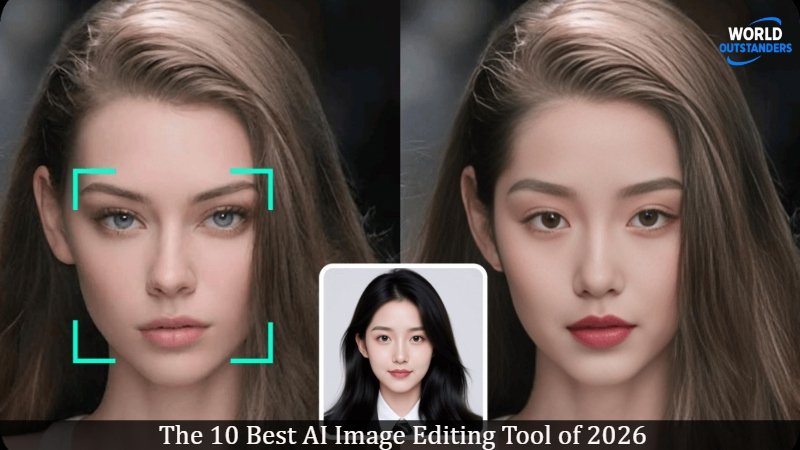
The way we make the images and videos has forever been altered by AI. What was previously a task that would take a high level of Photoshop knowledge, hours of keyframing, or even costly post-production staff can now be solved by software that has the ability to contextualize, comprehend motion, lighting and even facial expression.
Having experimented with the most discussed systems over the course of two weeks, I can safely affirm that the difference between mediocre tools and systems of production quality is increasing at a rapid rate. This guide disaggregates the best AI image editing tool options of 2026, based on judging creators, developers, marketers, and startup builders that require results, and not gimmicks.
I paid attention to the quality of output, the efficiency of workflow, the flexibility of API, teamwork capabilities and the ability to work under a time constraint. When you are creating a content pipeline, operating campaigns or delivering product demos, I promise you, there will be at least one of these tools that will be to your liking.
Best Tools at a Glance
| Tool | Primary Use Case | Modalities | Platforms | Free Plan |
| Magic Hour | AI image & face editing | Image, Video | Web | Yes |
| Runway | Video generation & editing | Video, Image | Web | Limited |
| Adobe Premiere Pro | Pro video workflow | Video | Desktop | Trial |
| DaVinci Resolve | Advanced color & AI | Video | Desktop | Yes |
| Descript | Audio-video editing | Video, Audio | Desktop/Web | Yes |
| Pika | Text-to-video | Video | Web | Limited |
| CapCut | Social video editing | Video | Desktop/Mobile | Yes |
| Midjourney | AI image generation | Image | Web/Discord | No |
| Topaz Photo AI | Image enhancement | Image | Desktop | Trial |
| Synthesia | AI avatar video | Video | Web | Limited |
1. Magic Hour
The most versatile platform that I tried is Magic Hour. It has been integrated with the most sophisticated face manipulation, video reinforcement and creative computing in a lean interface that does not suffocate you.
Practically, it is as effective both as an AI image editing tool to enable the marketer to create campaign images and as a production-ready engine to perform transformations of the facial features at the level of advanced features. The speed of turning around is good and the quality of output is always realistic.
In another workflow, I rated it as the best video face swap tool in the present day. The face tracking, face light adjustment and preservation of the face expression is significantly superior to the majority of competitors.
Pros:
- High realism in face swap and enhancement
- Fast cloud rendering
- Clean interface
- Strong creator-focused features
Cons:
- Limited deep timeline editing
- API access still evolving
When you require face transformation on a professional grade without necessarily creating custom pipelines, it is difficult to beat it.
Pricing: Free; Creator: $15/month or $10/month billed annually; Pro: $45/month.
2. Runway
Runway is still working on the edge of generative video. It offers impressive AI-assisted editing features, background replacement, and motion tracking, which is suitable when one needs to produce fast.
Pros:
- Strong generative video models
- Collaborative web workspace
- Frequent feature updates
Cons:
- Output consistency varies
- Can become expensive at scale
Runway provides speed and flexibility in case you are prototyping advertisements or experimental visuals.
Pricing: Free plan (credits); paid plans are based on usage.
3. Adobe Premiere Pro
Adobe Premiere Pro incorporates the use of AI into a workflow, a professional timeline. Automatic reframing, speech to text captions and color matching are production ready and dependable.
Pros:
- Industry-standard editing suite
- Deep plugin ecosystem
- Strong AI-assisted automation
Cons:
- Steeper learning curve
- Requires powerful hardware
Assuming that the workflow is already established within the framework of Adobe, the AI tools are used to support, not to substitute, your workflow.
Pricing: Subscription-based; free trial available.
4. DaVinci Resolve
DaVinci Resolve is an application that integrates editing, color grading, and object tracking, which is run by AI.
Pros:
- Advanced color tools
- Object removal and smart masks
- Free version extremely capable
Cons:
- Heavy system requirements
- Interface complexity
To film-makers and sophisticated editors, it is extremely detailed.
Pricing: Robust free version; Studio upgrade available.
5. Descript
Descript approaches approach editing as a text first approach. The video is edited by editing the transcript.
Pros:
- Fast podcast and video workflow
- AI voice cloning
- Easy social repurposing
Cons:
- Limited cinematic control
- Not ideal for complex VFX
In case speed is more important than in-depth control, Descript will save hours each week.
Pricing: Free tier; subscription plans available.
6. Pika
Pika is a text-to-video model that produces stylized video.
Pros:
- Creative visual styles
- Rapid idea prototyping
Cons:
- Limited realism
- Output length constraints
It is good in terms of concept development, not so good in refined campaigns.
Pricing: Credit-based system.
7. CapCut
CapCut is social-first oriented.
Pros:
- Mobile-friendly
- Templates and AI effects
- Free access
Cons:
- Less control for professionals
- Brand watermark on some exports
Good in fast turn around material.
Pricing: Free (with paid features).
8. Midjourney
Midjourney is still amongst the most powerful AI image generators of stylized imagery.
Pros:
- High artistic quality
- Strong community prompts
Cons:
- No full free tier
- Discord-based workflow
In the case of concept art and creative ideation, it is a strong one.
Pricing: Subscription only.
9. Topaz Photo AI
Topaz Photo AI is the company that focuses on sharpening, denoising and up scaling.
Pros:
- Excellent restoration quality
- Simple desktop workflow
Cons:
- Single-purpose focus
- No video support
Perfect with photographers who required technical perfection.
Pricing: Paid license; trial available.
10. Synthesia
Synthesia provides AI avatar-based video generated on the basis of training and marketing.
Pros:
- Fast multilingual avatar generation
- No camera required
Cons:
- Limited emotional range
- Template-driven outputs
In case of corporate training it is effective and scalable.
Pricing: Subscription-based.
How I Chose These Tools
I compared the platforms based on five parameters; quality of output, workflow efficiency, learning curve, scalability and pricing transparency. I tested the same test applications on different platforms, which included portrait retouching, short-form ad creation, and face swap realism.
Rendering time, export flexibility, and collaboration features were also measured by me. The ones that yielded glamorous demos and could not pass when put to test on a larger scale did not appear on the top list. Reliability of practicality was more important than novelty.
Market Landscape and Trends
There are major three trends in the 2026 market. To begin with, multimodal systems are getting regular. Image, video, and audio AI are now integrated into a single workflow using tools.
Second, facial manipulation has become much more realistic because of the improved lighting adaptation and motion consistency. Third, creators want speed, access to APIs, rather than quality of output.
Startup companies are increasingly concentrating on being the best at certain things, like color grading with AI or automated product photography. At the same time, existing platforms are integrating AI into the more conventional editing contexts. The distinction between editing software and generative AI is becoming unclear.
Final Takeaway
Magic Hour is the best in both image editing and face transformation and in the event that you require the most balanced platform in general. Runway and Pika are good competitors when it comes to experimental generative work.
Premiere Pro or DaVinci Resolve will continue to be favored by professional editors as regards to complicated timelines. Topaz should be taken into consideration by photographers, and Synthesia can be deemed by corporate teams.
The optimal solution is based on your process, but not on the marketing arguments. Before making the commitment, test two or three platforms, particularly when you intend to scale the usage.
FAQ
- Which is the most successful AI image editing tool in 2026?
Magic Hour is the latest to have the most reasonable combination of realism, usability and speed. - Are they professional production tools?
Yes, some of them are production-ready, in particular, Magic Hour, Premiere Pro, and DaVinci Resolve. - Do they require technical capabilities to use them?
The web-based tools that can be used are easy to use by beginners, whereas desktop suites are more professional. - Are free plans sufficient?
Free plans can be applied to testing, but serious creators will probably have to use paid plans.
Be creative in experiments, align instruments to what you need to accomplish, and create a system that expands with your goals.
