
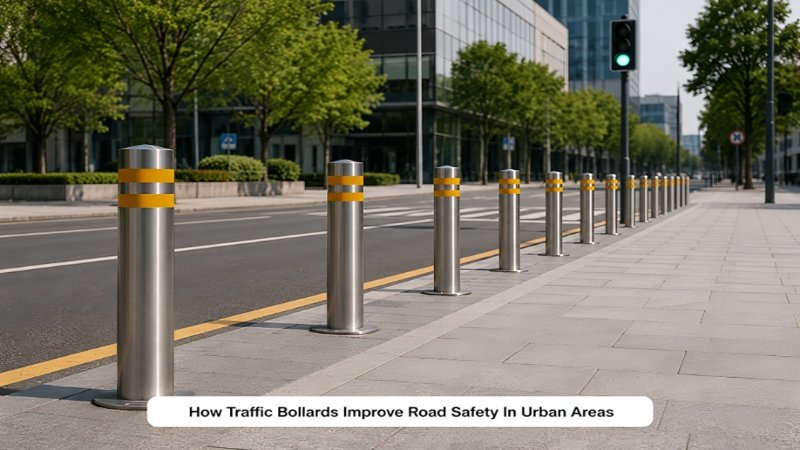
As soon as you arrive on a congested city road, you can sense it: the frenzied chaos, the non-stop activity, the unpredictable flow of vehicles, and people. Urban areas are bustling, but they can also be wild. One wrong turn, one distracted driver, and things can quickly go from normal to dangerous.
But there’s more to it than you might think; there’s more going on behind the scenes. Those simple, sturdy posts lining sidewalks and roads? They’re not merely for looks.
Traffic bollards serve an important, unobtrusive, and discreet purpose in helping to keep cities safer, more organized, and easier to navigate.
If you’ve ever wondered how something so small can make such a big difference, you’re about to find out.
1. Create Clear Boundaries Between Vehicles and Pedestrians
Imagine yourself standing on a busy street, with cars whizzing by just inches away. Doesn’t it seem uncomfortable?
This is where a traffic bollard enters the picture. Pedestrian bollards are used to define pedestrian walkways and vehicle lanes, providing a physical barrier for drivers to avoid.
In many cities, sidewalks are frequently blocked by vehicles, either purposefully or inadvertently. Without barriers, cars can roll down curbs, be parked in the wrong place, or even roll into a pedestrian area. The bollards serve as an effective barrier and provide a safe space for people to walk.
The separation is not only to prevent accidents but to build confidence. A safe environment promotes walking, exploration, and interaction with the environment. And that peace of mind in a busy urban environment is worth a lot.
2. Help Control Traffic Flow and Reduce Congestion
City traffic can look like an endless puzzle. Cars trying to get ahead, drivers making split-second decisions, traffic building up fast–it’s a lot to deal with. The secret, however, is that traffic bollards help quell the chaos.
Strategically placed bollards in urban design can help direct vehicles more predictably and safely along roadways, at intersections, and at entry points. Bollards can prevent illegal turns, illegal access, and guide traffic into lanes.
This level of control helps remove driver confusion. A well-understood road layout reduces the chance of risky driving behaviors or sudden braking that can lead to an accident. This helps with general traffic flow and gradually reduces congestion.
We cannot forget the ripple effect. Smoother traffic will lead to fewer delays, less frustration, and a reduced risk of road rage incidents. It’s a small change that makes a big difference to how you drive your car.
3. Protect Critical Infrastructure and Public Spaces
There are many assets in the cities: buildings, utility networks, outdoor seating, public venues, etc. However, these are susceptible to accidental or intentional impacts from vehicles. That’s where traffic bollards are unobtrusively our helpers in urban settings.
Bollards act as protective shields around sensitive areas. They can deter vehicles from crashing into storefronts, damaging public property, or entering restricted areas. Bollards are also used in areas where there may be a risk of attack, such as government buildings or public squares.
However, they do so without disrupting the city’s flow, making them even more interesting. Bollards are smaller and more inconspicuous than barriers or fences. They blend in with the landscape and provide high levels of protection.
The combination of safety and aesthetics is very important in urban design. Bollards help achieve the balance between security and welcoming in the city.
4. Reduce the Risk of High-Speed Accidents
One of the major factors in road accidents is speed. A collision is more likely to cause serious damage the higher the vehicles’ speeds. But how can cities get motorists to slow down without constant policing? Here again come the traffic bollards.
If drivers notice bollards in the street or a narrowing roadway, they automatically slow down. These structures are there to indicate the need to take caution. Also, bollards are used to create traffic-calming zones, where roads are intentionally designed to slow vehicles down.
This psychological impact is strong. Drivers are more aware, more attentive, and more cautious about their surroundings, and more aware of pedestrians and their movements. This will therefore reduce the risk of high-speed collision.
Lowering speeds in places such as school zones, neighborhoods, or bustling marketplaces can save lives. This is an easy, effective method to improve street safety, not just through speed limits and traffic signs!
5. Support Flexible and Smart Urban Planning
The city is a constantly changing place. New companies start, and populations expand and change. This calls for adaptable urban infrastructure. Traffic bollards are highly useful in modern urban planning and offer flexibility.
Some bollards are permanent and provide long-term protection and structural support. Some are temporary and removable or retractable, enabling temporary changes in road usage. For instance, a street open to automobiles during the day may be closed in the evening to serve as a pedestrian area.
This flexibility can be used in smart urban design. Cities can try various layouts, conduct new traffic patterns, and be flexible in reacting to changing requirements. Bollards are useful in situations such as events, construction, and emergencies to make adjustments without disrupting traffic.
And best of all, this adaptability helps make cities more people-centric. Creating safe and accessible cities for pedestrians can make these places more inclusive, livable, and enjoyable for all.
Final Thoughts: Small Structures, Big Impact
Traffic bollards could, at first glance, appear to be simple, limited-use metal posts. As you’ve seen, this has an impact that’s much deeper than meets the eye. From protecting pedestrians and controlling traffic to safeguarding infrastructure and reducing accidents, bollards play a vital role in making urban environments safer and more efficient.
The bottom line: Road safety doesn’t always require expensive and large-scale solutions. It is sometimes the little things that make a big difference. Traffic bollards come to mind here. They operate behind the scenes, influencing the interaction between people and vehicles in the same environment.
With urban development on the rise, the need for well-designed cities has never been greater. And while you may not always notice them, those sturdy posts along the road are doing more than just standing there; they’re actively protecting lives.
So, the next time you’re in the middle of a busy neighborhood while driving, take time to observe the bollards around you. They may be basic, but their job is to keep you safe.
