
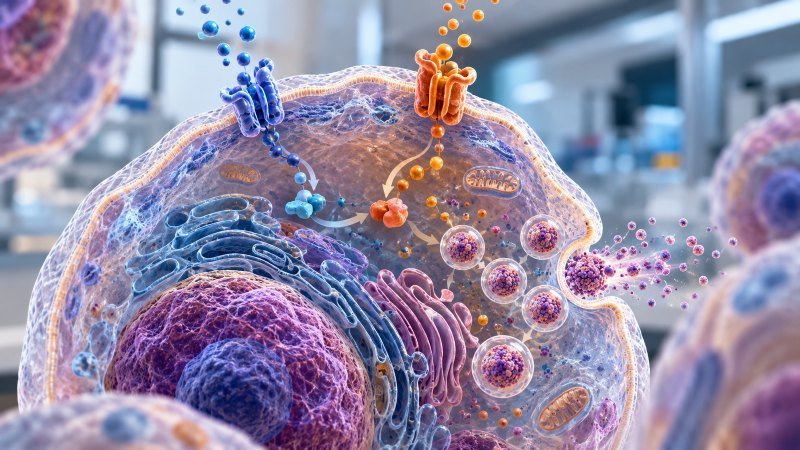
Endocrine signaling involving anterior pituitary somatotrophs provides a sophisticated biological model for studying convergent G-protein-coupled receptor (GPCR) cascades across cellular systems. Somatotroph cells express distinct cell-surface receptor families that regulate growth hormone synthesis, storage, and pulsatile exocytosis.
The primary stimulatory cascade is governed by the growth hormone-releasing hormone receptor (GHRHR). This receptor couples to Gs alpha proteins to stimulate adenylate cyclase. This process increases intracellular cyclic adenosine monophosphate (cAMP) levels and activates protein kinase A (PKA).
Meanwhile, the growth hormone secretagogue receptor (GHS-R1a) couples to Gq/11 proteins and stimulates phospholipase C (PLC). This signaling pathway mobilizes intracellular calcium through inositol 1,4,5-trisphosphate (IP3).
In modern preclinical endocrinology, molecular pharmacology, and cell signaling laboratories, researchers utilize synthetic growth hormone secretagogue research peptides to characterize the molecular synergy between these distinct signaling axes. Understanding how cAMP elevation and calcium mobilization interact at the intracellular level provides fundamental insights into somatotroph vesicle docking, membrane fusion dynamics, and downstream endocrine homeostasis across diverse cellular models and tissue cultures.
Synergistic Secretagogue Interactions in Somatotroph Cultures
When primary anterior pituitary cells are exposed simultaneously to GHRH analogues and selective ghrelin mimetics, they release more growth hormone than the sum of their individual responses. This non-linear, synergistic effect occurs because PKA phosphorylation prepares secretory vesicles for calcium-dependent exocytosis. At the same time, IP3-mediated calcium influx triggers rapid vesicular release. Consequently, dual secretagogue regimens produce robust physiological signaling at lower molar concentrations of each ligand.
Furthermore, evaluating synthetic analogues such as modified GRF (1-29) alongside selective pentapeptide secretagogues like Ipamorelin allows investigators to study receptor activation without stimulating unselected neuroendocrine pathways. Ipamorelin displays high binding specificity for GHS-R1a without cross-reacting with central adrenocorticotropic or prolactin receptors. This specificity allows researchers to isolate somatotropic mechanisms while avoiding confounding variables in hormonal profiling assays.
Receptor Desensitization and Internalization Dynamics
A critical consideration in experimental endocrine pharmacology is preventing rapid receptor tachyphylaxis and downregulation. Continuous exposure to high-affinity agonists frequently triggers G-protein coupled receptor kinase (GRK) phosphorylation and beta-arrestin recruitment, leading to endocytosis and lysosomal degradation of cell-surface receptors. Using short-acting peptide secretagogues that mimic natural pulsatile dynamics minimizes prolonged receptor occupancy, preserving receptor sensitivity over extended experimental protocols.
In vitro continuous perfusion assays demonstrate that intermittent, pulsatile peptide administration maintains stable somatotroph responsiveness across multiple challenge cycles. This characteristic makes dual secretagogue co-administration models especially valuable for studying long-term cellular adaptation, metabolic substrate shifting, and insulin-like growth factor-1 (IGF-1) gene expression in vitro.
Transcriptional Regulation of Downstream Metabolic Pathways
Upon activation of the GH/IGF-1 axis in preclinical tissue models, downstream transcriptional networks modulate lipid oxidation, glucose uptake, and nitrogen retention. In peripheral hepatocytes and myocytes, elevated growth hormone pulses promote the transcription of genes involved in fatty acid beta-oxidation while sparing glycogen stores. Studying these metabolic gene networks provides researchers with valuable tools for investigating cellular bioenergetics and systemic nutrient partitioning.
Additionally, monitoring changes in circulating binding proteins, such as IGFBP-3, helps map how cellular signaling events translate into systemic metabolic adaptations over extended testing periods in animal models.
Analytical Validation and Sourcing Criteria in Peptide Pharmacology
To ensure high reproducibility across preclinical research environments, synthetic secretagogues must undergo comprehensive analytical characterization. High-performance liquid chromatography (HPLC) is employed to confirm chromatographic purity, verifying that samples are free from truncation sequences and diastereomers. Electrospray ionization mass spectrometry (ESI-MS) confirms exact molecular mass and sequence alignment, while amino acid analysis (AAA) establishes net peptide content.
Adhering to strict analytical testing standards ensures that experimental findings accurately reflect intrinsic biochemical interactions rather than artifacts introduced by synthesis contaminants or degraded fragments, advancing scientific knowledge in molecular endocrinology and cellular pharmacology.
