
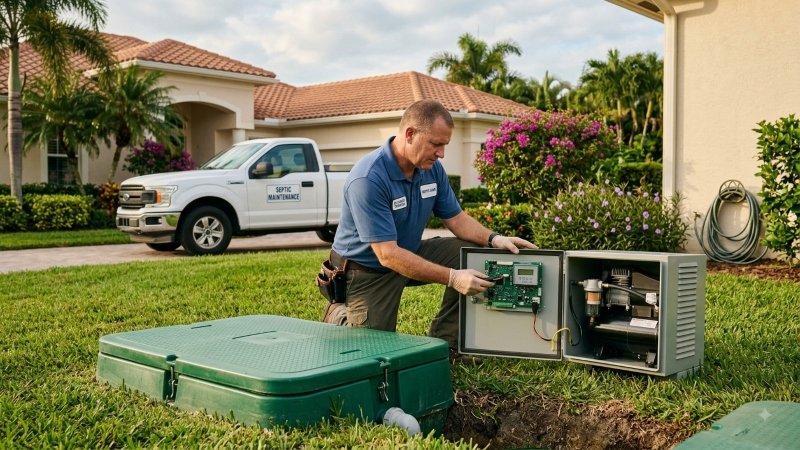
The honest answer is that an aerobic treatment unit costs money every year it runs, and the only year that felt free was the one your builder had already priced into the house. When that agreement expires nobody sends a reminder, so the atu service palm beach fl plans that pick up where the builder stopped tend to go unbooked for a year or more. Meanwhile the panel light has been amber since spring. Nobody has opened the lid since the builder’s technician stopped coming, and what sits out there now is, functionally, a holding tank with an air pump bolted to it. Here is the whole argument in one sentence: two years of scheduled service costs less than one aerator replacement, and far less than a drain field.
The Builder’s First Year Contract Hid The Real Cost
New construction folds that first year of maintenance into the price of the home, which means you never saw an invoice for it. So the number sitting in your head for keeping this system alive is zero. That is the myth, and it is an expensive one. The builder bought an agreement from a licensed maintenance provider because the unit needed one from the day it was switched on, and the cost was simply part of your closing statement.
Those visits were never a formality. A technician listens to the air pump, checks the chlorinator, tests the alarm circuit and walks the ground above the drain field, and the EPA’s septic technical resources, which I pulled up again in August 2026, still recommend watching that ground for ponding and wet areas as the way to catch a failure before it becomes a replacement. The case we see most often is a system that had been showing that exact sign for months with nobody scheduled to look at it. The panel light had been doing its job. Nobody was listening.
An Aerobic Unit Is Not A Passive Tank
A conventional septic tank separates solids and lets time do the rest. An aerobic unit treats. The blower runs most of the day pushing air into the treatment chamber so the bacteria that need oxygen, the ones doing the actual cleaning, stay alive and stay dominant, which is how the effluent reaching a drain field ends up far cleaner than what leaves a conventional tank. Cut the air for a few weeks and that population collapses. The tank keeps filling and the outlet keeps discharging, and the only thing that changed is the quality of what you are putting into the soil.
Five or ten years ago these units were easier to keep an eye on: a linear compressor, a diaphragm kit, a float, and an owner who could hear from the back porch when the thing stopped humming. Newer panels have run time counters, alarm relays and sometimes a text notification, which is better engineering, and it also means a unit can report a problem for six months into an empty yard. One rule has not changed at all. Never open a septic tank and lean in to look, and never let anyone else do it either. The gas in that space kills people every year, so keep the lid secured and let a licensed technician be the one who opens it.
Two Years Of Service Against One Aerator
So price it. An ATU service Palm Beach FL contract is a predictable line item, and an aerator failure is not. The comparison worth running is two years of scheduled visits set against a single unplanned parts bill on a five hundred gallon per day unit, which is the size most of these newer homes are carrying. Neither column is a quote, and your address will move both of them, but the shape of the answer barely changes from one property to the next.
Say the agreement runs $190 a year for two scheduled visits, an alarm check and a written report. Two years of that is $380. Add chlorine tablets at roughly $35 a year, so another $70, then one $60 callout in August when the alarm trips during a wet week, and the two years of ownership comes to $510 all in. Now the other column. A replacement aerator with labor on that same unit tends to land somewhere near $850, and that is the good outcome, because it assumes the field survived the months the system spent discharging poorly treated effluent. If it did not, you are pricing a new drain field instead, and no service agreement in the county costs anything close to that.
What actually fails is rarely dramatic. Job after job it is the diaphragm in the compressor, a chlorinator that ran dry in March and never got refilled, or a capacitor that quit while the family was away for two weeks. Each of those is a cheap part and a short visit when somebody is scheduled to find it. Left alone, that same short list is what turns a treatment unit into storage, and storage is what ruins a field. Delay does not make either number smaller. It only decides which of the two you end up paying.
A Service Plan Is Cheaper Than A Rebuild
Put that amber light on a calendar instead of a worry list. A unit that gets looked at twice a year, with tablets topped up and a blower replaced before it seizes, spends its whole life doing the job it was engineered for, and the field downstream of it lasts the way it was supposed to. In Florida, the rules covering who may service an aerobic unit and how often sit with the state health department and your county, so ask them what applies at your address rather than taking any contractor’s word for it. Then get the lid opened. The first visit after a lapse is the one that tells you whether you are buying maintenance or buying a rebuild.

Malik Bilal is the Editor at World Outstanders. With 3+ years of experience in business and technology writing, he creates clear, research-driven content on business, tech, health, and lifestyle topics, always focused on accuracy, trust, and practical value.