
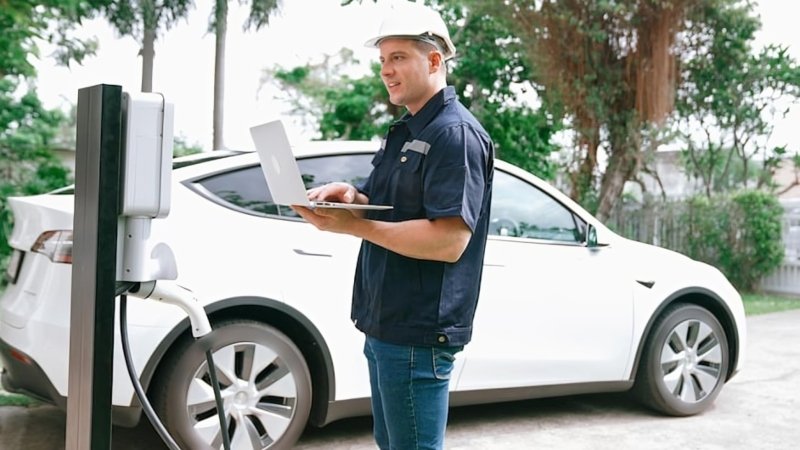
The charger clicks on at nine at night, the garage stays quiet for maybe twenty minutes, and then the breaker snaps off, and the car sits at 41 percent until morning. Homeowners in 1990s subdivisions run into this the first week after the install, and the honest diagnosis usually comes from a licensed electrician toledo oh rather than from the charger app. The argument here is simple. A Level 2 charger that keeps tripping is rarely defective; the real fix is a load calculation and a dedicated circuit, not a bigger breaker wedged into a full panel.
The Myth That Any Outlet Charges An EV
The myth goes like this. A charger is just another appliance, the garage already has power, so any open slot in the panel will do. Reality is less friendly. A 48-amp Level 2 unit is what electricians call a continuous load, meaning it pulls current for three hours or more without a pause, so the conductors and the breaker feeding it get sized above the charger’s actual draw rather than right at it. Share that circuit with a garage freezer or an air compressor and the breaker will keep doing its job at midnight, over and over, while everyone blames the car.
Running a Level 2 charger on an undersized or shared circuit is an overheating and fire hazard. A load calculation and a dedicated circuit installed by a licensed electrician are the requirement here, not an upsell. Before anyone opens that panel, confirm the contractor’s license and proof of insurance through your state or county government, which is what federal consumer regulators tell homeowners to do before any home improvement work.
What A Load Calculation Actually Reveals
A load calculation is a worksheet, not a hunch. It totals the fixed appliance loads, the general lighting and receptacle load, and the largest heating or cooling load, then weighs all of that against what the service can still carry. Any licensed electrician toledo oh homeowners call should hand that worksheet over without being asked twice. It matters more than the brand on the charger, and federal fire researchers reported an estimated 5,718 electric and plug in hybrid vehicle fires in a February 2026 multi source analysis, which is reason enough to treat the circuit feeding the car as carefully as the car itself.
Run the numbers on that suburban two story with the attached garage. The service is 150 amps, and the calculated demand already sitting on it, a range at 9,600 watts, a dryer at 5,500, an air conditioner near 4,800, plus lighting and receptacles, works out to roughly 88 amps. A 48 amp charger adds 60 amps of continuous demand, which brings it to 148 amps against a 150 amp service. Call that a pass. Honestly, closer to a fail, because a July evening with the air conditioning cycling leaves no headroom at all, and the practical answer is a charger dialed down to 32 amps or a service upgrade instead. Local amendments and inspectors vary by jurisdiction, so the worksheet your own city accepts is the one that counts.
Why The Right Circuit Beats A Cheap Workaround
Cheap workarounds have a look to them. A splice into the dryer circuit, a load sharing gadget from a marketplace listing, an extension cord rated for a leaf blower, or a bigger breaker dropped onto the same undersized wire. That last one is the worst of the bunch, because the wire overheats long before the oversized breaker notices anything is wrong. Trade coverage of the 2026 National Electrical Code changes puts an arc flash from an overloaded panel or a loose connection near 35,000 degrees Fahrenheit, which is not a risk worth carrying to save a few hundred dollars on a garage circuit.
The right circuit is boring, and that is the whole point. One dedicated run, conductors sized for the load, a breaker matched to the wire, a permit where your city requires one, and the car charges through a cold week without anyone thinking about the panel. Ask for the load calculation before you accept the quote, keep the license and insurance paperwork, and read a tripping breaker as information rather than an annoyance. That trip is the cheapest warning a homeowner ever gets.

Malik Bilal is the Editor at World Outstanders. With 3+ years of experience in business and technology writing, he creates clear, research-driven content on business, tech, health, and lifestyle topics, always focused on accuracy, trust, and practical value.