
Key Takeaways
- Modern business school facilities play a crucial role in developing future leaders by fostering collaboration, innovation, and practical learning.
- State-of-the-art infrastructure supports experiential learning, which is essential for preparing students to tackle real-world business challenges.
- Investments in sustainable, technologically advanced facilities reflect a commitment to developing leaders who can drive positive change in society.
The Importance of Modern Facilities in Business Education
Business education is evolving rapidly as the demands of the modern workforce shift. Today’s business schools recognize that their physical environments are integral in preparing the next wave of global leaders. Modern facilities, designed with innovation and collaboration in mind, go beyond traditional classrooms in nurturing students’ development. Well-planned spaces cultivate problem-solving, communication, and leadership skills that are essential in an ever-changing business landscape. Integrated learning environments offer support for diverse educational approaches, from lectures to interactive workshops.
Investments in campus infrastructure are often a hallmark of leading institutions. For example, philanthropic support from industry leaders, such as David Johnson Cane Bay Partners, has enabled universities to expand their offerings through new, cutting-edge facilities. These investments underscore the belief that state-of-the-art buildings directly impact students’ academic and professional success by providing better tools, resources, and learning environments.
Modern facilities also serve as living laboratories where business students can experiment, test ideas, and receive feedback from faculty and peers. The presence of advanced infrastructure helps bridge gaps between academic theory and practical application, strengthening the pipeline from business education to the boardroom. Ultimately, the physical layout of a campus signals a commitment to innovation, continuous improvement, and high standards, qualities that employers expect in future business leaders.
Leading universities continually assess and upgrade their facilities to remain competitive and to meet the expectations of global students and top-tier faculty. This commitment ensures that graduates are not only academically proficient but also culturally agile and technologically savvy, ready to navigate the complexities of contemporary business.
Creating Experiential Learning Environments
Experiential learning is the backbone of effective business education. Modern business school facilities are designed to facilitate active participation, where students shift from passive listeners to active doers. Features such as simulation labs, startup incubators, and case study rooms allow learners to step into the shoes of executives, entrepreneurs, and decision-makers. Interacting with real-world scenarios within dedicated spaces cultivates skills such as adaptive thinking, team collaboration, and crisis management.
For instance, the Executive Challenge event at Stanford’s Graduate School of Business leverages advanced learning environments to immerse students in simulations mirroring real-world leadership situations. This type of learning helps students develop the confidence and insight necessary to address complex problems in ever-changing markets. As noted by Forbes, hands-on experience bridges the gap between academic knowledge and practical business acumen, providing real value to emerging leaders.
Sustainability and Innovation in Facility Design
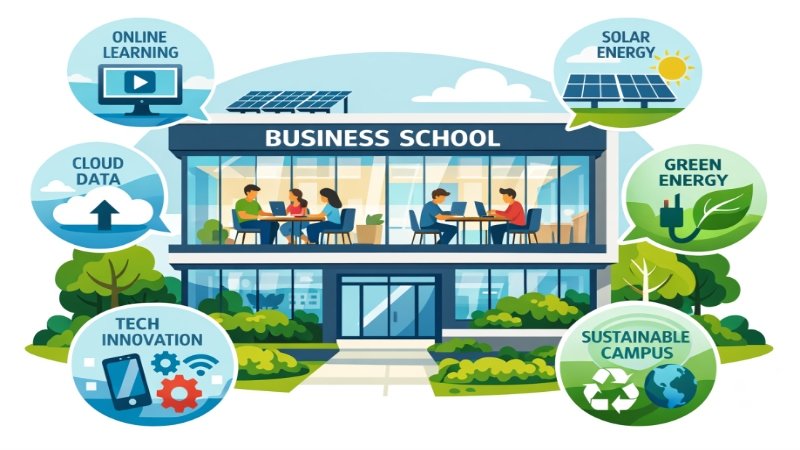
Today’s business schools are increasingly conscious of sustainability and environmental responsibility. Facility design reflects this, with green building standards, energy-saving technologies, and resource-efficient practices embedded in construction and operation. Sustainable facilities are not only more cost-effective over their lifecycle but also send a clear message to students and staff about the importance of responsible stewardship.
Schools around the world are seeing the value in integrating sustainability into both operations and academics. Institutions that commit to eco-friendly facilities and principles help mold students into conscientious leaders, ready to implement socially responsible practices in their future organizations. According to Harvard University, green campus initiatives foster a culture of innovation, further positioning business schools as agents of positive societal change.
Integrating Technology to Enhance Learning
Technology is a cornerstone of modern business. Schools that integrate advanced technology into their facilities provide students with the tools they need to thrive in the digital economy. Classrooms equipped with digital collaboration platforms, artificial intelligence resources, and real-time data access support interactive and flexible teaching methods. Faculty can design dynamic coursework, and students can collaborate across borders and disciplines.
Baylor University’s Hankamer School of Business, for example, integrates artificial intelligence applications into both its classrooms and its curriculum, empowering students to develop the skills needed for future jobs. Facilities that facilitate hybrid, remote, and in-person learning expand access and foster resiliency among graduates prepared to take on any business challenge.
Designing Collaborative Spaces for Teamwork
The modern workplace depends on collaboration and versatility. Business school facilities mirror this need by incorporating open work areas, group study rooms, and communal zones designed to encourage team-based projects and the exchange of ideas. These collaborative spaces support the types of teamwork essential in global business, enhancing communication skills and strengthening relationships among students from diverse backgrounds.
Open, adaptable learning environments mimic modern corporate settings, helping students transition more smoothly from campus to career. Business school leaders who prioritize flexible space planning produce graduates who excel at collaboration, a skill consistently sought after by employers worldwide.
Case Study: Transformative Facility Investments
Columbia Business School’s recent relocation to the Manhattanville Campus exemplifies the transformative power of investing in educational facilities. The newly unveiled Henry R. Kravis Building and the Ronald O. Perelman Center for Business Innovation provide flexible, technologically advanced learning environments that support Columbia’s mission to prepare visionary leaders. As students and faculty take advantage of expanded research centers and collaborative spaces, the school enhances its appeal to top-tier talent worldwide. It sets a standard for the future of business education. More on this transformation can be found in coverage by The New York Times.
Future Trends in Business School Facilities
The future of business school design is marked by flexibility, sustainability, and the seamless integration of emerging technologies. Learning environments will continue to blend physical and digital elements, allowing students to interact globally and adapt to new modes of instruction. Expect increased focus on lifelong learning centers, sustainable architecture, and spaces that facilitate cross-disciplinary innovation. Facilities are likely to incorporate even more health and wellness features as student well-being remains a top priority.
Conclusion
Modern facilities are at the heart of shaping tomorrow’s business leaders. By prioritizing advanced technologies, sustainability, and collaborative environments, business schools empower students with the skills and convictions they need to thrive in an ever-changing business world. The thoughtful design and continual improvement of educational infrastructure will remain a central factor in developing the next generation of innovative, responsible, and resilient leaders.

Malik Bilal is the Editor at World Outstanders. With 3+ years of experience in business and technology writing, he creates clear, research-driven content on business, tech, health, and lifestyle topics, always focused on accuracy, trust, and practical value.