
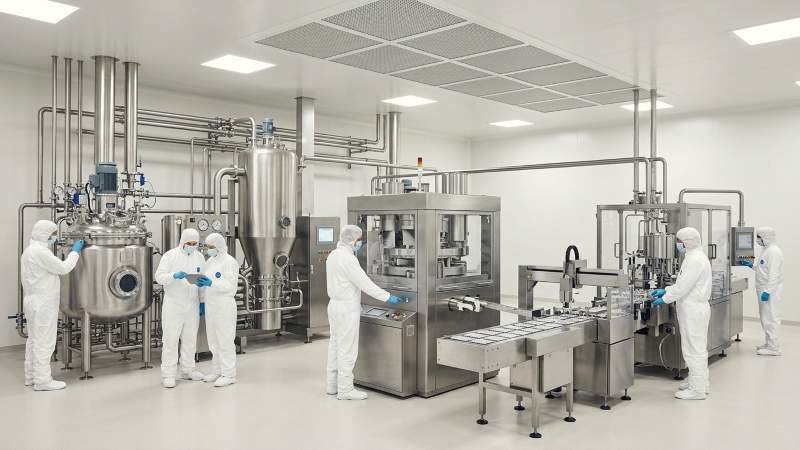
Modern pharmaceutical manufacturing is one of the most technically demanding industries in the world. Every tablet, capsule, injectable, or topical formulation that reaches a patient has passed through a carefully orchestrated sequence of machines, systems, and processes — each designed to meet exacting standards of purity, consistency, and safety.
Understanding the equipment that drives this industry is not merely an academic exercise; it is essential knowledge for engineers, procurement specialists, facility managers, and anyone involved in the lifecycle of a drug product. From raw material handling to final packaging, the machinery involved is as diverse as it is sophisticated.
Why Equipment Selection Defines Manufacturing Success
In pharmaceutical production, companies must choose equipment carefully. Regulatory agencies such as the FDA and EMA set strict guidelines for drug manufacturing, making equipment selection essential for compliance. Manufacturers must validate and maintain equipment to ensure easy cleaning and consistent batch results. Even a small deviation in temperature, pressure, or mixing speed can compromise an entire production run and, in severe cases, put patients at risk.
Beyond compliance, equipment selection directly impacts operational efficiency and cost. Facilities that invest in well-matched, high-quality machinery tend to experience fewer breakdowns, lower contamination risks, and better yield rates. This is why experienced manufacturers approach equipment procurement with the same rigor they apply to formulation development itself.
Core Categories of Equipment in Pharmaceutical Facilities
Mixing and Blending Systems
Pharmaceutical manufacturers must combine ingredients uniformly throughout the production process. They use blenders, granulators, and high-shear mixers to distribute active pharmaceutical ingredients (APIs) evenly across each batch. Ribbon blenders handle dry powder mixing, while planetary mixers and high-shear granulators work with formulations that contain moisture or binders. The goal is consistent homogeneity, ensuring every dose contains the correct amount of active ingredient.
Size Reduction and Milling Equipment
Particle size has a profound effect on drug bioavailability and dissolution rates. Mills and grinders — including hammer mills, jet mills, and cone mills — are used to reduce raw materials to precise particle sizes. This step is critical not only for efficacy but also for downstream processing, as finer particles blend more uniformly and compress more predictably into tablets.
Tablet Compression and Encapsulation
Rotary tablet presses are among the most recognizable pieces of equipment in solid dosage manufacturing. These machines compress blended powders into tablets at high speeds, often producing hundreds of thousands of units per hour. Encapsulation machines, on the other hand, fill hard or soft gelatin capsules with powders, pellets, or liquids. Both types of equipment require precise calibration and regular maintenance to ensure weight uniformity and dosage accuracy.
Coating Systems
Many tablets require a coating — either for taste masking, moisture protection, or controlled release. Pan coaters and fluid bed coaters apply thin polymer films to tablet cores in a controlled environment. The process demands careful management of airflow, temperature, and spray rate to achieve a uniform, defect-free coat. Enteric coatings, which prevent a tablet from dissolving until it reaches the intestine, are a particularly specialized application of this technology.
Sterile Manufacturing: A Different Set of Demands
Injectable drugs and ophthalmic preparations require sterile environments and specialized equipment that exceed the needs of solid dosage forms. Autoclaves use pressurized steam to sterilize equipment and containers. Lyophilizers, or freeze dryers, remove moisture from sensitive biologics without exposing them to damaging heat. Isolators and restricted access barrier systems (RABS) protect products from contamination during filling. These systems require significant capital investment, and pharmaceutical facilities must operate them correctly to protect patient safety.
The Role of Sourcing and Procurement Expertise
Selecting the right pharmaceutical process equipment requires deep industry knowledge, access to a broad inventory of both new and pre-owned machinery, and an understanding of how specific equipment performs under real-world manufacturing conditions. Companies that specialize in sourcing, evaluating, and supplying process equipment play a critical role in helping manufacturers scale up quickly, replace aging assets, or outfit entirely new facilities. Their expertise can mean the difference between a smooth production launch and costly delays.
Maintenance and Operational Continuity
Even the most advanced pharmaceutical equipment is only as reliable as the maintenance program supporting it. Preventive maintenance schedules, calibration records, and equipment qualification protocols are all part of a robust quality management system. Facilities that neglect maintenance often face unexpected downtime, failed batch records, and regulatory scrutiny. Investing in service contracts and skilled maintenance personnel is not an overhead cost — it is a strategic investment in production continuity.
This principle extends beyond pharmaceutical settings. Industries that rely on complex mechanical systems — from HVAC to industrial processing — understand that proactive service is always more cost-effective than reactive repair. For those managing service logistics in other sectors, resources like ATU service maintenance cost guidance offer useful frameworks for budgeting and planning equipment upkeep across different operational environments.
Innovation on the Horizon: What’s Shaping the Future of Manufacturing
The pharmaceutical equipment landscape is not static. Continuous manufacturing — as opposed to traditional batch processing — is gaining traction as a way to improve efficiency and reduce variability. Advanced process analytical technology (PAT) tools allow real-time monitoring of critical quality attributes, enabling manufacturers to make in-process adjustments rather than relying solely on end-product testing. Automation and robotics are increasingly being integrated into filling lines and packaging operations, reducing human error and improving throughput.
Looking ahead, industries are paying closer attention to the energy demands of large-scale manufacturing. As companies worldwide explore cleaner energy sources, researchers and engineers are investigating how next-generation power technologies could support industrial operations. Fusion energy, for example, could eventually transform how energy-intensive industries generate and use power. Research into fusion reactor designs also offers insight into the technology’s potential role in large-scale manufacturing over the coming decades.
International Process Plants: A Trusted Resource for Equipment Sourcing
Pharmaceutical manufacturers need reliable process equipment for new facilities, capacity expansions, and replacement projects. International Process Plants offers evaluated equipment and industry-focused sourcing support for these needs. Its team understands the technical and regulatory requirements of pharmaceutical production.
This expertise helps manufacturers identify equipment that supports operational goals and compliance requirements. The company combines industry knowledge with practical procurement support, making it a useful resource for manufacturers at different stages of growth.
Conclusion
Pharmaceutical manufacturing is built on a foundation of precision, and that precision begins with the equipment. From the earliest stages of raw material processing to the final packaging of finished dosage forms, every machine in a pharmaceutical facility contributes to the safety and efficacy of the products it helps create.
Understanding what that equipment is, how it functions, and how to source and maintain it effectively is essential knowledge for anyone operating in this demanding and critically important industry. As technology continues to evolve, so too will the tools that make modern medicine possible — and staying informed about those developments is a competitive advantage no manufacturer can afford to overlook.

Malik Bilal is the Editor at World Outstanders. With 3+ years of experience in business and technology writing, he creates clear, research-driven content on business, tech, health, and lifestyle topics, always focused on accuracy, trust, and practical value.