
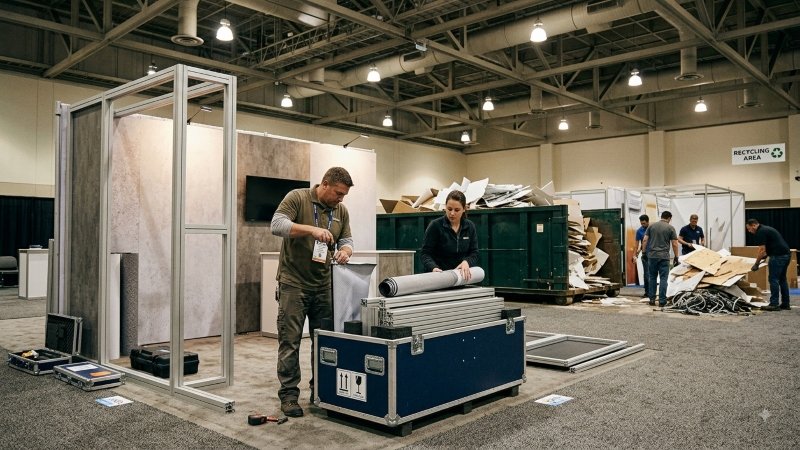
A booth that lasts one weekend is not the cheap option. It only looks cheap on the first invoice, which is why the most useful thing to ask a custom trade show booth company is how many shows the structure is engineered to survive, not what the build costs. Small consumer brands feel that gap hardest. A company that prints a compostable packaging promise on every carton, then watches a crew cut its ten by twenty booth into scrap on Sunday night, has a contradiction that no recap deck smooths over.
Show floors are enormous, and the volume of material crossing them is easy to underestimate from a laptop. AVIXA reported that InfoComm 2026, held in June 2026 at the Las Vegas Convention Center, brought together 807 exhibitors across 395,500 net square feet. Most of what fills a footprint like that arrives in crates. Some of it leaves in a dumpster instead, and for a brand whose whole story is reuse, that is the part that stings long after the badge scans are tallied.
Single Use Builds Contradict A Reuse Claim
The failure rarely looks like a failure while it is happening. A brand books four shows for the year, approves a design for the first one, and finds out at teardown that the panels were bonded rather than bolted, so nothing comes apart in a condition worth keeping. The case we see most often is not a bad build. It is a good build with no second life planned into it, and that plan costs almost nothing to add while the drawings are still open. A structure designed to ship, rebuild and refresh across a season costs less per show than a fresh build every time, and it keeps the brand’s floor presence from arguing with its own carton.
Nobody photographs the dumpster for the recap deck. It is still the most honest measurement the program produces.
Weight is where the argument turns concrete. Exhibit people talk about drayage, which is simply the fee the show contractor charges to move your crates from the loading dock to your space and back again, billed by weight. A one-time build pays that fee exactly once and then stops existing. A structure meant for the season pays it four times and spreads a hypothetical fabrication figure, say somewhere near nine thousand dollars for a mid-size footprint, across four separate audiences instead of one Friday crowd.
Questions That Reveal How A Builder Works
Vendor conversations drift toward renderings, which is where they are most fun and least revealing. What actually predicts the second year is how the thing comes apart, where it sleeps between shows, and what it costs to say something new on it. Four questions do most of the sorting, and how specific the answer gets matters more than the answer itself.
- How does this structure come apart, and what does reassembly look like without your original crew on site? A good answer names a tool list and a build time in hours.
- Which surfaces are meant to be reprinted between shows, and which ones are structural? A good answer separates the graphic skin from the frame and prices a refresh of each.
- How is it crated, and what does the packed structure weigh? A good answer gives a shipping weight in pounds, because weight is what you pay to move.
- Where does it live between shows, and who carries the risk while it sits there? A good answer states a monthly storage rate and who is liable for damage in the warehouse.
None of that requires learning the vocabulary. (You will pick some up anyway, and most of it turns out to be dull once translated.) A builder who answers in hours, pounds and dollars is describing a system somebody has already rebuilt in a parking lot at six in the morning. A builder who answers in adjectives is describing a picture.
Design For The Fourth Show, Not The First
Designing for the fourth show changes early decisions in quiet, unglamorous ways. Frames get bolted instead of bonded. Graphics get sized to a standard panel, so a new message costs a reprint instead of a rebuild, and the counter that fronted a product launch in spring can front a different one in autumn without reading as a leftover. A booth earns its budget the second time it is used, not the first. The opening weekend is only the down payment on the structure.
So the standard worth holding a custom trade show booth company to, before anything is cut or printed, is not whether the render looks good on a Tuesday afternoon call. It is whether the structure has a plan for the shows that come after this one, in writing, with weights and crate counts attached. The eco-minded brand in this story got there the hard way, through one Sunday night teardown and one very quiet Monday, and its replacement now travels home in the same crates it left in. The loading dock keeps score, and the packaging and the booth finally tell the same story.

Malik Bilal is the Editor at World Outstanders. With 3+ years of experience in business and technology writing, he creates clear, research-driven content on business, tech, health, and lifestyle topics, always focused on accuracy, trust, and practical value.