
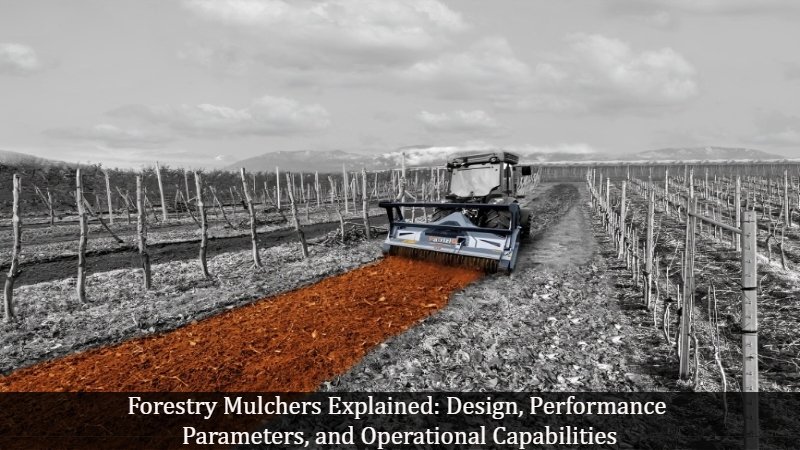
Effective vegetation management requires more than raw power. In forestry and land clearing operations, productivity depends on the ability to process dense biomass efficiently, safely, and with consistent output quality. Equipment selection, therefore, becomes a technical decision, not simply a matter of horsepower.
Within this context, forestry mulchers represent one of the most versatile and performance-driven solutions. Their mechanical architecture, power transmission systems, and material processing capabilities directly influence operational efficiency, fuel consumption, and long-term durability.
Mechanical Design Architecture
The mechanical architecture of a forestry mulcher determines its structural reliability, cutting efficiency, and ability to withstand continuous high-load conditions. Every component – from the rotor to the transmission system – plays a decisive role in overall productivity.
Rotor Configuration and Cutting Performance
The rotor is the core functional element of the mulcher. Fixed-tooth configurations provide aggressive penetration and stable performance when processing dense wood and larger diameters, while swinging hammers offer adaptability in lighter vegetation. Rotor mass, inertia, and balance directly influence torque stability and the ability to maintain consistent RPM under variable load, ensuring uniform material reduction and controlled output quality.
Structural Strength and Wear Resistance
Operating in abrasive and impact-intensive environments requires reinforced frames manufactured from high-strength steel. Integrated counter-blades improve fragmentation efficiency, while replaceable wear components protect high-stress zones. Structural robustness is essential to withstand torsional forces, shock loads, and continuous exposure to rocky or uneven terrain.
Transmission Efficiency and Power Management
Whether PTO-driven or hydraulically powered, efficient torque transfer is critical. Mechanical driveline systems and optimized hydraulic flow management reduce energy losses and heat generation while maintaining rotor stability. Overload protection mechanisms further safeguard both the mulcher and the carrier, minimizing mechanical stress and downtime.
Operational Capabilities Across Applications
Modern forestry mulchers are engineered to operate across a wide range of environments, adapting to different carriers and vegetation densities. Their operational versatility makes them essential in projects that require controlled biomass reduction, surface conditioning, and long-term vegetation management.
- Forestry maintenance and land reclamation. Used to process shrubs, trees, and residual biomass, mulchers enable surface restoration and site preparation with uniform material distribution.
- Right-of-way maintenance. Ideal for managing vegetation along power lines, oil and gas corridors, railways, and roadsides, where controlled cutting and consistent mulching are required to maintain access and safety compliance.
- Fire mitigation and firebreak creation. By reducing fuel load and producing evenly distributed mulch layers, mulchers support preventive strategies in wildfire-prone areas.
- Stump shredding and surface biomass management. Designed to reduce stumps to ground level and process residual material, improving terrain usability without the need for additional removal operations.
Intelligent Systems and Productivity Optimization
Technological advancements have enhanced how forestry mulchers manage power under variable working conditions. Modern control systems regulate hydraulic flow and stabilize rotor performance to maintain consistent operating parameters during material processing.
Automatic calibration enables the mulcher to adapt to changes in vegetation density, reducing rotor stalling and limiting sudden RPM drops under heavy load. By improving torque stability and response time, these systems enhance cutting consistency while reducing mechanical stress on both the attachment and the carrier.
The result is improved fuel efficiency, lower downtime, and longer component lifespan – making intelligent power management a decisive factor in demanding operations.
Selecting the Right Forestry Mulcher: A Technical Approach
Selecting a forestry mulcher requires a structured technical evaluation rather than a simple comparison of nominal horsepower. Productivity and durability depend on the correct alignment between the attachment, the carrier, and the operating environment, which should be assessed through the following criteria:
- Carrier type and available horsepower. The mulcher must match the carrier’s effective power output. Imbalances may result in reduced rotor performance or excessive driveline stress.
- Hydraulic flow and pressure (for hydraulic-driven units). Adequate flow rate and stable pressure are essential to maintain consistent RPM under load and prevent frequent stalling.
- Maximum material diameter capacity. Rated diameter should reflect real operating conditions, considering material density and workload continuity.
- Terrain conditions. Abrasive or uneven soils require reinforced structures and enhanced wear protection to ensure durability.
Engineering Decisions That Drive Long-Term Performance
In professional vegetation management, equipment selection is a strategic engineering choice. Evaluating structural design, power dynamics, and operational context ensures that forestry mulchers deliver consistent output under real working conditions. When technical alignment is prioritized, performance becomes predictable, downtime is reduced, and long-term operational efficiency is significantly improved.
FAE Forestry Mulchers: Technical Excellence for Demanding Field Operations
Since its founding in 1989, FAE has specialized in the design and manufacture of advanced attachments for land clearing, vegetation management, forestry operations, and demining applications.
With decades of cross-sector expertise spanning agriculture, infrastructure maintenance, and environmental management, the company has established itself as a benchmark in mechanical innovation and operational reliability. Its range includes a comprehensive lineup of heads for tractors, excavators, skid steers, tracked carriers, and special vehicles.
Within a portfolio of more than 400 models across over 90 product families, forestry mulchers represent one of FAE’s core technologies. These units are manufactured using high-strength steel, reinforced structural components, and advanced wear-resistant materials to ensure long service life and stable performance.
Designed to handle dense vegetation – trees, brush, trunks, stumps, and roots – FAE forestry mulchers can process material up to 20 inches in diameter. Their cutting systems deliver precise and consistent results across diverse environments, from steep or uneven terrain to post-fire areas and infrastructure corridors.
Built for continuous operation, these machines maintain cutting efficiency without compromising structural integrity, making them suitable for demanding tasks such as site preparation, biomass reduction, and forest maintenance.
Compatibility with a wide range of carriers and multiple configuration options further enhances their versatility. This adaptability allows professionals to operate efficiently in complex and variable field conditions where durability, flexibility, and performance are critical.
Through ongoing investment in engineering development and product refinement, FAE continues to provide solutions that elevate performance standards in professional vegetation management worldwide.
