
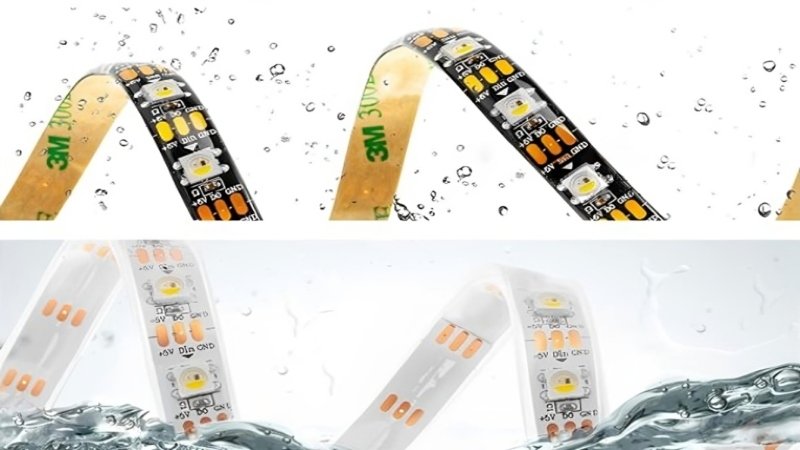
When you begin searching for the best LED lights for outside, you are immediately confronted with a sea of technical jargon. Among the most critical—yet most misunderstood—specifications are the IP ratings. You see these two letters followed by two numbers on every box, every spec sheet, and every product description. But what do they actually mean for your patio, your garden, or your swimming pool?
Choosing the wrong rating can lead to a costly “short-circuit” in your project, while over-specifying can lead to unnecessary spending. In this technical deep dive, we will decode the Ingress Protection (IP) system and help you determine whether you need a standard water-resistant LED strips solution or a fully submersible industrial-grade product.
Decoding the IP System: What the Numbers Represent
The IP (Ingress Protection) rating is an international standard (IEC 60529) used to define the levels of sealing effectiveness of electrical enclosures against intrusion from foreign bodies and moisture.
The First Digit: Solid Protection (0–6)
The first number refers to the protection against solid objects like dust, dirt, and even fingers.
- Rating 6: This is the highest level for solids. It means the device is “Dust Tight.” No ingress of dust is permitted; complete protection against contact. For any outdoor project, you should insist on a ‘6’ as the first digit to prevent fine grit from scratching the LED chips.
The Second Digit: Liquid Protection (0–9)
The second number is the one we care about most for outdoor projects. It ranges from 0 (no protection) to 9 (high-pressure steam jets).
- 5: Protection against low-pressure water jets from any angle.
- 7: Protection against temporary immersion in water (up to 1 meter for 30 minutes).
- 8: Protection against continuous immersion in water (depth specified by the manufacturer).
Understanding the gap between these numbers is the key to finding the best LED lights for outside.
IP65: The “Weatherproof” Standard
IP65-rated LED strips are typically encased in a thin silicone “sleeve” or have a spray-on epoxy coating.
Best Use Cases
IP65 is suitable for areas that are sheltered from direct, heavy rain. Think of under-eave lighting, covered porches, or indoor damp areas like bathrooms. They can handle the occasional splash and high humidity, but they are not designed to sit in a puddle or be hit by a high-powered pressure washer.
The Limitations
The primary weakness of IP65 is the “breathing” effect. As the LEDs heat up and cool down, the air inside the sleeve expands and contracts. This can eventually pull in moisture from the surrounding air, leading to internal condensation and “fogging” of the lens, which reduces light output and eventually corrodes the circuitry.
IP67: The “Heavy Rain” Guardian
For most residential outdoor applications, IP67 is the “Sweet Spot.” These strips are usually fully encapsulated in a high-quality silicone tube that is then filled with a secondary sealant (solid encapsulation).
Why It’s Preferred for Outdoors
An IP67 rating means the light can be dropped into a meter of water for half an hour and come out working perfectly. In the real world, this translates to protection against torrential rain, melting snow, and heavy splashes from garden hoses.
If you are outlining a deck, a garden path, or a roofline where the light is exposed to the full force of the elements, water-resistant LED strips with an IP67 rating are your best bet. They offer the durability needed to survive seasonal changes without the extreme cost of specialized underwater lighting.
IP68: The “Submersible” Professional
IP68 is the highest standard for consumer and industrial lighting. However, it is important to note that IP68 is a “variable” rating—it means the light is suitable for continuous immersion, but the manufacturer must specify the depth.
When Is It Mandatory?
- Swimming Pools and Ponds: Any light that will live underwater 24/7 must be IP68.
- Low-Lying Areas: If you have a garden bed that floods during every storm and remains underwater for hours, IP67 may eventually fail. IP68 provides the peace of mind that no amount of standing water will penetrate the seal.
- Dock Lighting: For marine environments where waves and constant submersion are factors.
The Construction Difference
The best LED lights for outside with an IP68 rating often use a “double-extrusion” or “vacuum-filled” silicone process. This eliminates all air pockets inside the strip. Without air, there is no pressure differential to suck water in, and the strip can withstand the constant physical pressure of the water at depth.
Beyond the Numbers: Materials Matter
A rating is only as good as the material providing the protection. Two strips can both be rated IP67, but their lifespans will differ wildly based on the casing material.
Epoxy Resin (The Budget Choice)
Many cheap “waterproof” strips use epoxy resin. Over time, UV rays from the sun cause epoxy to turn yellow and become brittle. Once it cracks, the IP rating becomes meaningless as water seeps into the cracks.
Silicone (The Professional Choice)
Professional water-resistant LED strips use high-grade silicone. Silicone is UV-stable, meaning it stays crystal clear even in direct sunlight. It is also flexible, allowing it to expand and contract with temperature changes without cracking.
Common Failure Points: Where the Rating Fails
Even the best IP68 light will fail if the installation is poor. Most “waterproof failures” don’t happen in the middle of the strip; they happen at the ends.
- The Cut Points: When you cut an LED strip to fit your space, you break the waterproof seal. You must use specialized end caps and professional-grade RTV silicone sealant to re-seal the cut end.
- The Connection: The point where the wire meets the strip is the most vulnerable area. Using “Heat-Shrink” tubing with an internal adhesive is the only way to ensure this connection remains watertight.
- Cable Wicking: Believe it or not, water can travel inside the copper wire through a process called capillary action. If the other end of your wire is sitting in a damp junction box, water can be “sucked” into the LED strip from the inside out.
How to Choose: A Quick Decision Matrix
To help you decide which is the best LED lights for outside for your specific needs, follow this simple guide:
| Environment | Recommended Rating | Key Consideration |
| Under Eaves / Covered Porch | IP65 | Focus on dust protection and high CRI. |
| Open Deck / Garden Path | IP67 | Ensure UV-resistant silicone casing. |
| Near Sprinklers / Heavy Rain | IP67 | Use aluminum channels for extra shielding. |
| Ponds / Pool Waterlines | IP68 | Depth specification is critical. |
| Coastal / Saline Environments | IP68 | Must be salt-spray resistant. |
Conclusion: Don’t Guess, Spec Properly
Choosing the right IP rating is about balancing risk and reward. For the majority of outdoor projects, IP67 provides the perfect blend of durability and value. However, for specialized water features, there is no substitute for the absolute protection of IP68.
By understanding these technical nuances, you can ensure that your water-resistant LED strips don’t just look great on the night of the installation, but continue to shine bright through rain, snow, and sun for years to come. When you invest in the best LED lights for outside, you aren’t just buying light; you are buying the engineering that keeps the dark—and the water—at bay.